
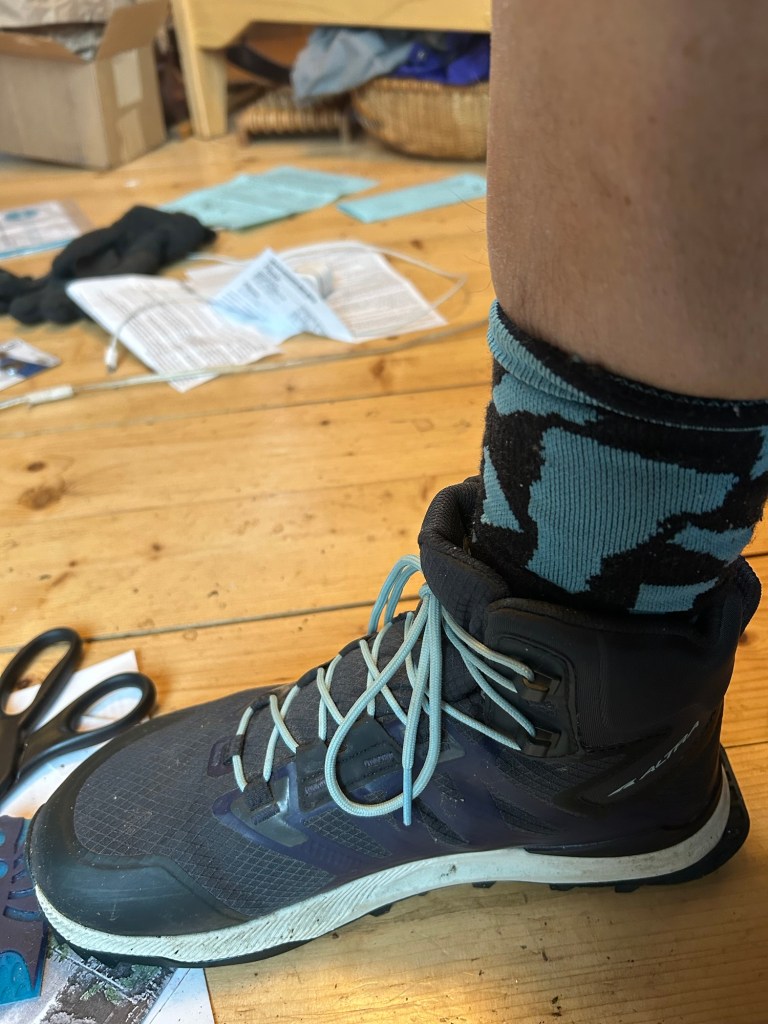
An important thing to determine on each hike is what shoes to wear. For the Florida trail I found this fairly challenging because of the many swamps and promise of wet feet for much of the trail. Also, since this is the first big hike, I’m doing after breaking both my feet on the Pacific Northwest trail. I thought long and hard about what shoes I wanted to use.
In the 1960’s through the 90’s many hikers used really heavy leather boots, but by the mid 80s this was starting to change. We had begun to question the belief that we had to have heavy hiking boots, especially when it was being recognized that every pound on your foot was the equivalent of carrying 5 pounds on your pack. Eventually lightweight boots became the norm. Today most hikers don’t even use boots, relying instead on trail runners. This is not a possibility for me because I don’t have most of the ligaments in my ankles still intact. I need the support of a boot to keep me from rolling and breaking my ankles while hiking.

For a number of my recent hikes I used Hoka boots. I loved some of them while other models I really hated, so along with the make of a boot one has to be aware of the model. Hoka boots and shoes are liked on trails because of the cushioning they provide. But they are definitely on the expensive end and wear out extremely fast. I’ve had to re-glue lugs or complete soles back onto the boots within just 100 miles. Many people on the Arizona Trail were replacing their Hokas after only 300 miles of hiking. While some people are fine replacing shoes that often, I find it difficult to spend close to $200 on a pair of boots only to have them fall apart after a few hundred miles of walking. After dealing a number of times with less than stellar customer service from Hoka, I decided to try different boots on the Arizona and Pacific Northwest trails. I found some Keenes at a really good price and was really happy with them on the Arizona Trail. My one pair of boots easily made the whole 800 mile journey and when early on a hook broke off the top of the boot, Keene sent me a new pair with no questions asked. I did miss the cushioning of the Hokas but I enjoyed the wide toolbox of the Keenes which prevented any blisters. I do wonder if the lack of cushioning contributed to my broken feet on the Pacific Northwest trail, though I suspect the breaks happened because I twisted my feet in the horrible bushwhacks of that trail.

I’m trying different boots for the Florida Trail. I found a pair of really cheap Altas, which is a popular brand on trail. This pair of boots is actually a size too big for me but since the price was right, I figured I would add a second pair of insoles, giving myself some additional cushioning. I also have a pair of Topo boots which I have never used before, but which I also was able to get at a somewhat reduced price. While my physical therapist is encouraging me to use the Topos because of their stability, I’m hesitant because it seems an inner seam rubs my foot in such a way that might cause problems.
I have decided to start hiking with the lighter weight Altras and to have the topos on hand to be mailed to me if I need a second pair of boots further up the trail. Whenever I do a long trail, I try to have a second pair of broken in boots on hand. Luckily my friend Deb in my hometown of Vermont is willing to hold the boots for me and to mail them should the need arise. Some people say the swamps at the start of the Florida Trail completely destroy your shoes. Other people have said they’ve managed to do the entire trail with one pair of shoes. I guess I shall soon find out.
#thru hike #thruhiker #nationalscenictrails #floridatrail #iceagetrail #iat #connecticutriverpaddlerstrail #appalachiantrail #pct #azt #arizoniatrail #pnt #pacificnorthwesttrail #potomacheritagetrail #phnst


 The Mary Badass
Leave a reply to sbdelattre Cancel reply